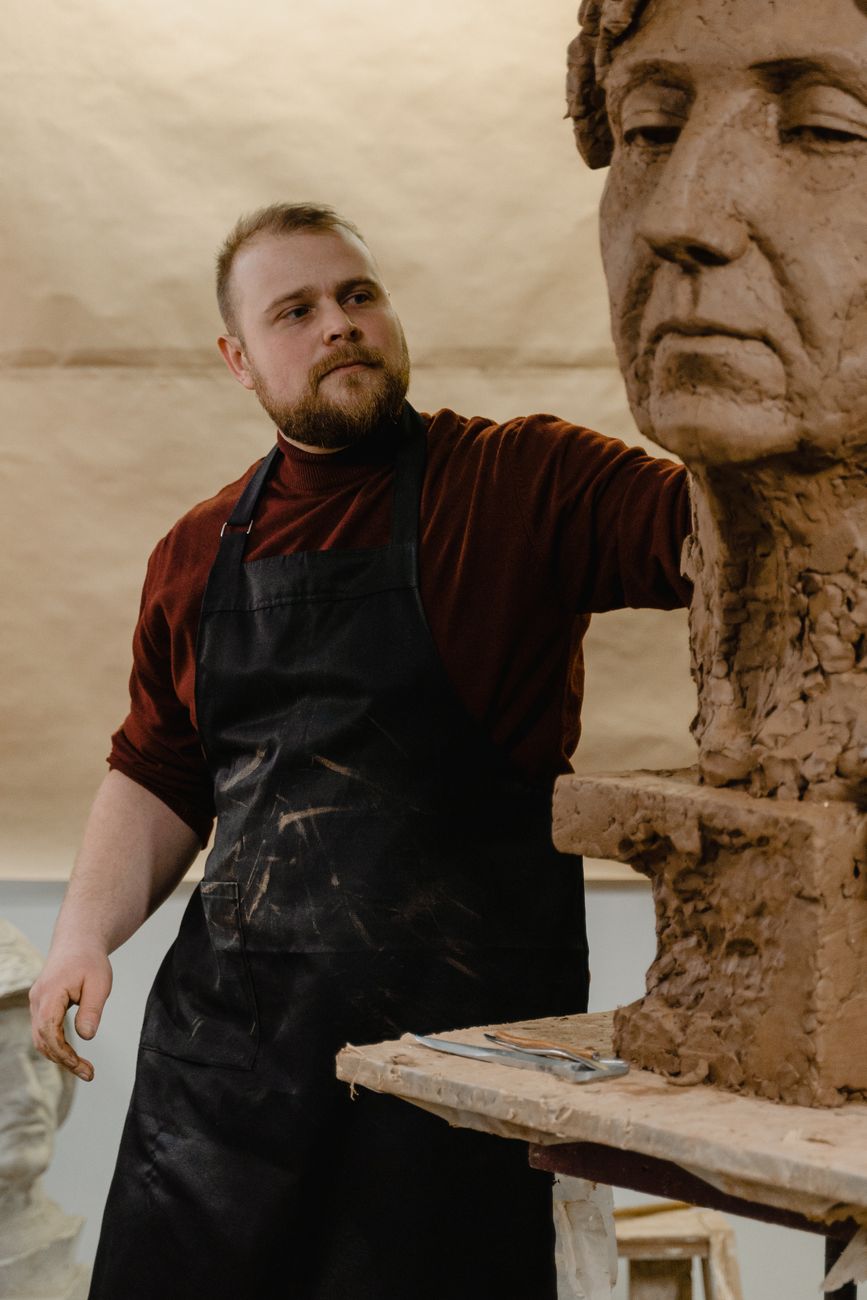
The Sculptor's Journey: A Contemporary Figurative Sculptor Profile
What does it take to sustain a decades-long career as a figurative sculptor? The paths of three contemporary sculptors—each rooted in classical technique yet unafraid of innovation—reveal a common blueprint: immersive artistic education, a deliberate return to cultural and human context, and relentless adaptation to studio constraints. Their stories show that the sculptor's journey is not a linear ascent but a cyclical process of learning, unlearning, and reconnecting with the human form. This profile draws on the careers of G. Ravinder Reddy, Steven Whyte, and Giorgos Georgiadis to explain how figurative sculptors build enduring practices while remaining relevant in an art world that often prizes the abstract.
How Do Contemporary Figurative Sculptors Build a Lasting Career?
A lasting career in figurative sculpture rests on three pillars: technical mastery acquired through immersive study, a conceptual connection to one's culture and environment, and the flexibility to evolve with changing circumstances. These elements are evident in the trajectories of sculptors like Steven Whyte, who trained in the classical tradition and dedicated his life to bronze, and G. Ravinder Reddy, whose education extended far beyond formal schooling to include extensive travels and museum visits across Europe. Their experiences underscore that the sculptor's journey is as much about seeing the world as it is about shaping clay.
The journey often begins with formal training but accelerates when the artist learns to look beyond the studio. Ravinder Reddy attributes his major artistic education to visiting museums and cathedrals during travels in Europe, which opened up his vision. This real-world exposure complements academic learning, providing a visual and cultural vocabulary that no textbook can replicate. Similarly, Steven Whyte's commitment to the classical tradition gave him a foundation in anatomy and technique that allowed him to create works resonating with the human experience. For artists seeking to emulate this path, the lesson is clear: combine structured education with deliberate exposure to artistic heritage, both historical and contemporary.
What Role Does Cultural Context Play in Figurative Sculpture?
Cultural context transforms figuration from mere representation into a meaningful dialogue with the audience. This principle is central to understanding why many sculptors pivot toward local subject matter. Ravinder Reddy's return to India after studying abroad exposed him to what he perceived as a disconnect in contemporary Indian art: artists were imitating European abstract trends rather than responding to their own cultural environment. He felt that abstract sculptures were not eliciting a response from viewers because they were alienated from the local context. This realization prompted him to create works based on his surroundings, leading to the iconic female heads that have become his signature.
For contemporary figurative sculptors, the takeaway is that cultural grounding is not a constraint but a wellspring of creativity. Whether it's Reddy's Indian women or Whyte's universal human narratives, the most compelling works emerge when artists engage with the stories, struggles, and beauty of their own society. This is a deliberate choice, as Giorgos Georgiadis's work demonstrates: although his practice spans nearly seven decades, he has consistently remained anthropocentric and figurative, expressing the stimuli and influences absorbed from his political, economic, and social environment.
What Was the Turning Point in Ravinder Reddy's Career?
The turning point for Ravinder Reddy came from a dual revelation: first, his European travels expanded his artistic vision; second, looking back at Indian contemporary art, he saw a landscape bereft of cultural rootedness. This informed his shift from abstraction to figuration, specifically the creation of large-scale female heads. These heads, initially emerging as a response to his environment, 'took a stronger, firmer form' over time, indicating an iterative process where artistic refinement accompanies conceptual clarity. This case exemplifies how a sculptor can pivot deliberately by responding to perceived gaps in the artistic discourse.
Why Do Sculptors Often Change Materials and Themes?
Change is not a deviation but a natural progression in a sculptor's career. Both Whyte and Georgiadis illustrate that versatility extends the artist's relevance and creative lifespan. Whyte's body of work, while rooted in bronze, demonstrates a nuanced exploration of human anatomy and emotion. Georgiadis explicitly notes that over his seventy-year career, he has engaged with and expressed himself through different materials, often working in one for a period before moving to another. This adaptability is a testament to artistic growth and a practical response to changing opportunities and inspirations.
A material change can also be pragmatic, as Georgiadis's 'seated female torso' series illustrates. He explains that one of his studios in Kallithea had a low ceiling, making it difficult to work on standing figures. That limitation birthed a years-long focus on the seated figure, a form that became central to his practice. This anecdote is a valuable lesson for sculptors: constraints are not enemies; they are catalysts for innovation.
How Do Fine Art Journalists Document the Sculptor's Journey?
Documenting such journeys involves more than an interview; it requires situating the artist's work within a broader narrative of art historical influences and personal evolution. Successful Artist Profiles and Interviews: A Complete Guide to Crafting Compelling Narratives emphasizes the need to contextualize technical choices and thematic developments within an artist's biography. For instance, a profile of Reddy would explore how his time at MS University, Baroda, and later London, combined with his travels, shaped his formative years. Similarly, a profile of Whyte might highlight his classical training as a foundation for his bronze works.
When writing about contemporary sculptors, journalists should look for pivotal moments, such as Reddy's realization that Indian art had become alienated from its culture. These moments provide a narrative arc that resonates with readers. Moreover, an authoritative profile might compare the approaches of different sculptors—like Whyte's classical bronze vs. Reddy's painted heads—to offer insight into the breadth of figurative practice. A useful framework is the 'tradition-versus-innovation' axis: examining how an artist honors classical techniques (as Whyte does) while innovating in subject matter or material (as Reddy does through his iconic head forms) and approaches to display (as Georgiadis did when he adapted to spatial constraints).
What Does the Future Hold for Figurative Sculptors?
Despite the dominance of conceptual and abstract art, figurative sculptors continue to find profound resonance with audiences. As Steven Whyte's example shows, a deep connection to the human form can forge works that are 'timeless and deeply personal,' proving that figuration is not obsolete but essential to the artistic dialogue. The careers of these sculptors suggest that future opportunities lie in the ability to adapt while maintaining technical excellence and cultural relevance. Emerging sculptors can draw inspiration from these established masters, and for those seeking recognition, 10 Emerging Contemporary Artists to Watch in 2025 might signal the kind of attention that builds momentum.
How Can Aspiring Sculptors Navigate the Art World?
Entering the art world as a sculptor requires both artistic development and strategic exposure. Interviews and profiles, such as Exclusive Interview: How Established Artists Maintain Relevance in a Changing Art World, reveal that established artists prioritize continuous learning and community engagement. Similarly, From Studio to Gallery: An Interview with a Successful Emerging Artist on Breaking Into the Scene underscores the importance of having a strong portfolio and articulating one's artistic vision. These practical steps can help sculptors bridge the gap between studio practice and public appreciation.
Executing a Sculptural Vision: From Conception to Bronze
The process of creating a figurative bronze sculpture, as practiced by Whyte, involves several distinct stages: sketching, modeling in clay, mold-making, and casting. Classical training emphasizes these steps, but contemporary sculptors also employ digital tools, such as 3D scanning and printing, to aid in the process. This hybrid workflow allows for precision while preserving the artist's hand. For young sculptors, mastering traditional techniques remains relevant, but additional skills like networking and self-promotion are crucial for a sustainable career.
Measuring Success in a Sculptor's Career
Success metrics for sculptors go beyond auction prices and gallery representation. They include public commissions, presence in museum collections, critical recognition, and impact on audiences. For example, Whyte's public monuments and statues indicate a successful practice, even as his figurative style contrasts with prevailing art trends. The key is to define what success means personally—whether it is artistic fulfillment, community engagement, or commercial viability—and to make strategic decisions that align with those values.
Key Takeaways for Aspiring Figurative Sculptors
The sculptor's journey, as illuminated by these profiles, offers practical lessons:
- Invest in immersive education: Travel, museum visits, and studying art history can expand your visual vocabulary.
- Ground your art in your cultural context: Art that responds to its environment often resonates more deeply with audiences.
- Embrace constraints: Limitations, such as a low studio ceiling, can lead to creative breakthroughs.
- Diversify your materials and methods: Changing materials can invigorate your practice and expand your range.
- Make learning a lifelong habit: Approach your work with the curiosity of a student, even when acknowledged as a master.
In an era dominated by conceptual art, the figurative sculptor's path is one of resilience and renewal. By blending classical skills with personal vision, these artists demonstrate that representing the human form remains a powerful means of storytelling. Their journeys are not linear stories of rise and fall but continuous spirals of growth—molding, breaking apart, and reshaping both the clay and themselves.
Revolutionizing Figurative Sculpture: A Case Study in Cultural Redefinition
Consider the case of Ravinder Reddy: after studying at MS University, Baroda, and in London, he used his European experience to objectively view Indian art. His critique of the alienation from culture catalyzed a redefinition of figurative sculpture in India. By creating monumental female heads informed by local aesthetics, he made a global impact, earning international acclaim. This narrative demonstrates how one artist's commitment to cultural authenticity can revitalize a tradition.
Conclusion
Through the profiles of three sculptors, this article has illuminated the quintessence of a sculptural career: it is a practice of adaptation, education, and self-expression. Steven Whyte, G. Ravinder Reddy, and Giorgos Georgiadis exemplify how sculptors can forge lasting careers by marrying classical foundations with contemporary relevance. They also prove that figurative art retains its power to speak to the human condition, even in an increasingly abstract world. For aspiring sculptors, the path is not hidden; it is paved with continuous learning, cultural dialogue, and an unwavering hand in clay. As the art world evolves, those who remain part of that dialogue—not as imitators, but as creators—will ensure that figurative sculpture continues to shape the future.